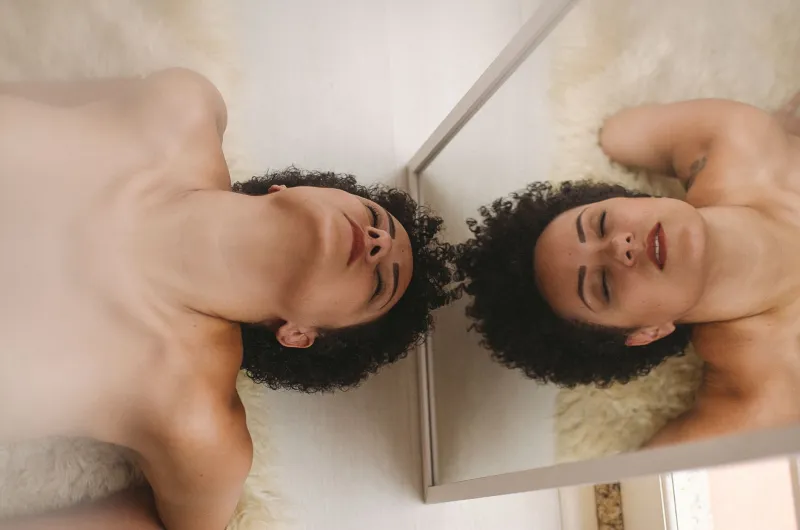
Mirror, Mirror — Why the Hair Type Staring Back at You Isn't the One You Think You Know

Somewhere along the way, the beauty industry handed us a numbered chart and said, "Find yourself here." Type 1, 2, 3, 4 — with letters tacked on for good measure — and suddenly we were all sorting ourselves into boxes designed more for marketing copy than for actual hair science. The problem? Those boxes were never built to hold the full complexity of what's growing out of your scalp.
If your routine feels like it's always almost working — products that perform beautifully in reviews but land flat on your strands, styles that hold for three hours then collapse — there's a solid chance you've been caring for the wrong version of your hair. Not because you're doing it wrong, exactly. But because the hair type you think you have and the one that actually lives on your head might be two completely different things.
The Curl Chart Was Never the Whole Story
The curl typing system — you know the one — became the dominant language of hair identity for a reason. It's visual, it's shareable, and it gave a generation of people with natural and curly hair a vocabulary they'd never had before. That matters. But over time, the system got flattened into something it was never meant to be: a product prescription.
Here's what the chart doesn't capture: two people can have the exact same curl pattern and need completely opposite routines. Why? Because curl pattern is just one variable. It tells you the shape of your strand. It says nothing about how that strand behaves — how it absorbs moisture, how quickly it loses it, how much stress it can handle before it snaps.
Those missing variables have names: porosity, elasticity, and strand thickness. And they matter more than your curl number ever will.
What Porosity Is Actually Telling You
You've probably heard of porosity — maybe even taken a float test (which, for the record, isn't nearly as reliable as the internet made it seem). But porosity isn't just a fun hair quiz result. It's the single biggest predictor of how your hair responds to everything: water, conditioner, oil, heat, humidity.
Low porosity hair has tightly packed cuticles. Products sit on top rather than soaking in. If you've ever felt like your hair just repels moisture — like water beads off it in the shower — you're probably dealing with low porosity, regardless of whether your curl pattern is a 2c or a 4b. High porosity hair, on the other hand, drinks everything up fast and loses it just as quickly. It's often the result of chemical damage, heat damage, or genetics, and it needs a totally different approach to moisture retention.
Here's where people go wrong: they buy products formulated for their curl type instead of their porosity. A rich, heavy butter that works beautifully on high-porosity coils will sit like concrete on low-porosity strands — even if those strands have the exact same curl pattern.
Elasticity: The Test Nobody Talks About
If porosity is about how your hair takes in moisture, elasticity is about what your hair does with it. Healthy elasticity means a wet strand can stretch and return to its shape without snapping. Poor elasticity — the kind that shows up as breakage, limp curls that won't spring back, or hair that feels mushy when wet — signals protein deficiency or structural damage.
To check yours: take a single wet strand and gently stretch it. Healthy hair should stretch about 30% before returning to its original length. If it snaps immediately, you're protein-deficient. If it stretches and doesn't bounce back at all, you've got hygral fatigue — too much moisture, not enough protein. Either way, the routine you thought your hair needed might be making things worse.
The Self-Assessment Framework You Actually Need
Forget the chart for a minute. Here's a more honest way to understand your hair:
Step 1 — Look at a single dry strand in natural light. Is it barely visible? Fine. Clearly visible but not thick? Medium. Looks like a piece of thread? Coarse. This is strand thickness, and it affects how much product your hair can actually handle.
Step 2 — Do the porosity slip test. Run a strand between your fingers from tip to root. If it feels smooth, low porosity. Rough or bumpy? High porosity. This is more reliable than the float test because it's assessing the actual cuticle structure.
Step 3 — Test your elasticity on a wet strand, as described above. This tells you whether your hair is craving protein, moisture, or balance.
Step 4 — Observe your scalp, not just your strands. Oily scalp with dry ends? Your hair is producing sebum but it's not traveling down the shaft — common in tightly coiled textures. Dry scalp and dry ends? You're dealing with a different issue entirely.
Step 5 — Notice how your hair behaves in humidity. Does it swell and frizz? High porosity or low elasticity. Does it fall flat? Possibly fine or low-density strands that can't hold structure against moisture.
Why Marketing Categories Keep Getting in the Way
Here's the uncomfortable truth: hair product marketing is built on aspiration, not diagnosis. The model with the perfect defined curls on the packaging probably doesn't have your porosity, your scalp type, or your strand thickness. She's selling a feeling, not a formula.
When you buy based on curl type alone — or worse, based on what's trending on your For You page — you're essentially playing product roulette. Sometimes it works. Often it doesn't. And when it doesn't, the easy assumption is that you did something wrong, when really the product was just never designed for what your hair actually needs.
This isn't about blaming the industry entirely. Curl typing opened doors and created community. But it's time to add more tools to the conversation.
Your Hair Is More Specific Than Any Category
The hair that lives on your head is a combination of genetics, history, environment, and choices — and it's almost certainly more nuanced than a number and a letter. Maybe you have low-porosity 3c curls that behave nothing like the high-porosity 3c curls you've been taking advice from. Maybe your 4a pattern is medium-stranded with great elasticity, which means the heavy butters everyone in your texture community swears by are actually weighing you down.
Getting to know your actual hair — not the idealized category version of it — is what separates a routine that almost works from one that genuinely does. Your crown doesn't owe anyone a clean classification. It just needs you to actually listen to it.