What If the Hair You've Been Fighting Isn't Even Yours?

Here's a question worth sitting with for a second: What if the texture you've been wrestling with every morning — the one that won't curl right, won't lay flat, won't do anything you want — isn't actually your natural hair texture at all?
For a lot of people, that's not a hypothetical. It's the reality hiding underneath years of heat styling, chemical processing, hard water buildup, and product layering. We build whole identities around our hair — and sometimes, the version we've been working with is more a product of our habits than our biology.
That's not a failure. It's just something worth knowing.
Why Your "Natural" Texture Might Be a Myth
Hair texture isn't as fixed as we like to think. Yes, your genetics establish a baseline — the shape of your follicle, the pattern your strands want to grow in, the natural thickness of each one. But that baseline is incredibly sensitive to what you do to it over time.
Take heat damage. Repeated use of flat irons, blow dryers on high, and curling wands doesn't just style your hair temporarily. Over time, it breaks down the disulfide bonds that give your strands their natural shape. Curl patterns loosen. Waves go limp. What looks like a "new texture" is actually structural damage that's accumulating slowly enough that you don't notice it happening.
Chemical processing — relaxers, perms, color treatments — does the same thing, sometimes more dramatically. Even frequent brushing on wet hair or tight styles worn for years can alter how your strands grow and behave at the root.
And then there's water. If you've been living somewhere with hard water (which, depending on where you are in the US, could absolutely be your situation), mineral deposits build up on the hair shaft over time. That buildup can make textured hair look straighter, make fine hair look coarser, and make almost any hair type feel heavier and duller than it actually is.
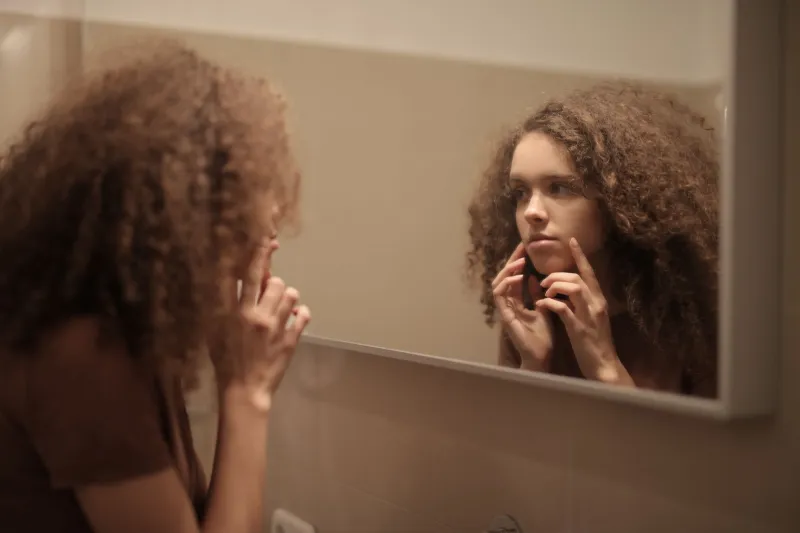
The point is: what you see in the mirror might be a composite of all the things you've done — not a clear picture of what your hair naturally wants to be.
The Signs That What You're Seeing Isn't the Whole Story
So how do you know if your current texture is "yours"? A few things to look for:
New growth behaves differently. If the hair closest to your scalp — the parts that haven't been touched by heat or chemicals yet — has a noticeably different pattern, curl, or wave than the rest of your length, that's your first clue. That new growth is your actual texture trying to introduce itself.
Your texture varies wildly between sections. Some variation is normal, but if different parts of your head seem to have completely different personalities, it's worth asking whether some sections have been treated differently over time.
Your hair only looks "right" with a lot of product or heat. If your routine feels less like enhancing your hair and more like forcing it into submission, you might be working against a texture that wants to do something else entirely.
You've never actually seen your hair in its fully untouched state. If you started heat styling or chemically treating your hair in your teens (or earlier), you might genuinely not know what your hair looks like without intervention. That's more common than people admit.
What It Takes to Actually Find Out
Discovering your real texture takes patience, and it's not a linear process. But here's a loose roadmap:
Step one: stop the source. You can't assess your natural texture while you're still altering it. That means pulling back on heat — or eliminating it entirely for a stretch — and pausing chemical treatments. This isn't forever, but it needs to be long enough to see real new growth.
Step two: address buildup. A clarifying wash (or a few, spaced out) can remove product residue and mineral deposits that have been sitting on your strands. You might be surprised how much your texture shifts once that layer is gone. Some people find their hair is significantly more textured or more pliable than they thought — just hidden under gunk.
Step three: let your hair air dry. Repeatedly. Without touching it. Without diffusing, without plopping, without scrunching in product. Just wash, apply a light leave-in if needed, and leave it alone. Do this several times over several weeks. What you see is data.
Step four: watch the new growth, not the length. Your ends carry the history of everything you've done. Your roots carry the truth. Pay attention to the first inch or two of growth — that's where your actual texture lives right now.
The Emotional Part Nobody Talks About
Here's what makes this process harder than it sounds: it requires you to let go of a version of your hair you might have spent a long time perfecting.
Maybe you've spent years achieving a certain look. Maybe that look is tied to how you feel confident, or professional, or like yourself. Finding out your "natural" texture is something different can feel disorienting — even a little like a loss.
That's real, and it's worth honoring. But it's also worth separating the question of what your hair actually is from the question of what you want to do with it. Those are two different conversations.
Knowing your real texture doesn't mean you have to wear it that way forever. It just means you're making informed choices instead of fighting a battle you didn't fully understand.
Give It Time You Probably Don't Want to Give It
Hair grows roughly half an inch per month. If you've been heat styling for a decade, you're not going to see your full natural texture in a few weeks. A realistic timeline to get meaningful information is somewhere between three and six months of consistent, low-manipulation care — longer if there's significant chemical processing in your history.
That's a long time. It's also a genuinely useful one. Because by the end of it, you won't just know what your hair looks like — you'll know how it behaves, what it responds to, and what it actually needs. That knowledge is worth more than any product on your shelf.
Your crown has a story it's been trying to tell. The question is whether you've been quiet enough to hear it.