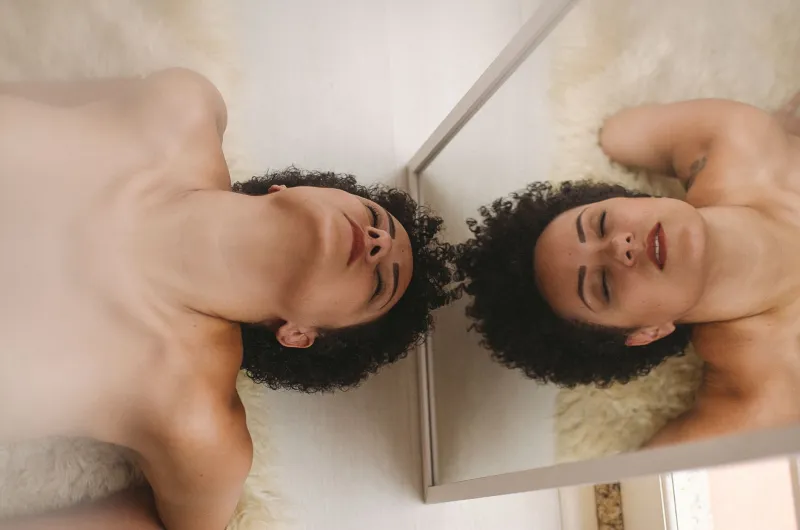
You've Been Calling Your Curls the Wrong Name — And Your Routine Is Paying the Price

The Chart Didn't Lie — But It Didn't Tell the Whole Truth Either
Somewhere along the way, most of us got handed a numbered grid — 2A through 4C — and were told to find ourselves in it. Maybe it was a YouTube video, a Reddit thread, or the back of a product box. And so we picked a number, claimed it like a zodiac sign, and started building our entire routine around it.
The problem? That grid was never designed to capture the full complexity of what your hair actually does. It was a starting point that got treated like a finish line.
Curl classification systems — even the more detailed ones — measure pattern shape under ideal conditions. Freshly washed, perfectly moisturized, no product buildup, no humidity interference. That's a controlled environment, not your Tuesday morning bathroom. So when you're standing there wondering why your "3B" routine keeps leaving your hair crunchy or undefined, it's worth asking: are you actually a 3B? Or did you just pick the number that matched the hair you wanted to have?
The Instagram Effect Is Real and It's Messing with Your Self-Perception
Let's be honest about something. A huge chunk of curl misidentification isn't about ignorance — it's about aspiration. Scroll through any natural hair hashtag and you'll see a very specific aesthetic dominating the feed: defined, bouncy, glossy spirals that look like they belong in a shampoo commercial. That image is beautiful. It's also heavily curated.
What you're seeing is often a combination of cast products, diffusing technique, strategic lighting, and yes — a particular hair type that photographs well in that format. When someone with looser waves or tighter coils sees that image and thinks "that's my hair," they're not being delusional. They're being human. We pattern-match. We want to belong to something.
But building a routine around someone else's curl pattern — even one that visually resembles yours — is like buying shoes in someone else's size because you liked the style. It might work okay. It probably won't feel right.
What Your Hair Actually Does vs. What You Think It Does
Here's a more useful framework than any numbered chart: observe your hair across multiple conditions over time.
Your curl pattern isn't one thing. It's a behavior. And that behavior shifts depending on hydration levels, product load, how you handle it when wet, how long it takes to dry, and even what season it is. Your hair might clump beautifully in summer humidity and shrink into a totally different shape in dry winter air. That's not inconsistency — that's your actual hair telling you exactly what it is.
Some things worth tracking:
Shrinkage percentage. How much length does your hair lose as it dries? High shrinkage (50% or more) usually signals a tighter pattern than people realize, especially if you've been eyeing your stretched length and using that as your reference point.
Clumping behavior. Do your strands naturally want to group together, or do they separate into individual coils? Clumping patterns tell you a lot about how your hair will respond to layering products.
Dryness rate. Hair that takes forever to dry usually has more density and tighter curl — both of which affect how moisture moves through the strand. If you've been using lightweight products designed for fine, loose waves and wondering why your hair feels perpetually thirsty, this might be your answer.
How your hair behaves on day two or three. First-day hair is a performance. The real pattern shows up when the product settles and your natural movement takes over.
The Mismatch That Costs You the Most
When your perceived curl type and your actual curl behavior are out of sync, the consequences show up in very specific ways.
People who underestimate the tightness of their curl often reach for lightweight products that aren't rich enough to penetrate or hold definition. They wonder why their curls fall flat by noon. People who overestimate — who think they have tighter coils than they do — tend to over-moisturize, weigh their waves down, and then assume their hair is "resistant" or "difficult."
Neither group is doing anything wrong, exactly. They're just working from the wrong map.
The product industry doesn't help here. Marketing language like "for 3C-4A hair" sounds specific, but those labels are doing a lot of work for a very wide range of textures. Two people can both technically be 4A and have completely different porosity levels, strand thickness, and scalp behavior — all of which matter more than the curl shape itself when it comes to what products will actually work.
How to Actually Figure Out What You're Working With
Step one: wash your hair with just shampoo and conditioner. No stylers, no leave-ins beyond a basic detangler. Let it air dry without touching it. What you're left with is as close to a baseline pattern reading as you're going to get.
Now look at it — not compared to anyone else's hair, not against a chart. Just look at what your hair is doing on its own terms. Where does it clump? Where does it separate? Is it forming spirals, waves, coils, or some combination of all three? Because here's the thing a lot of people don't talk about: most of us have more than one pattern on our head. The nape might be tighter. The crown might be looser. The temples might do something completely different. That's normal. That's actually the rule, not the exception.
Step two: pay attention to what your hair responds to over the next few weeks. Not what it's supposed to respond to — what it actually does. Does adding more moisture help or make things worse? Does protein make it feel stronger or stiffer? Does your hair prefer being left alone to dry or does it need encouragement through scrunching or shingling?
Your answers to those questions will tell you more about your hair than any chart ever could.
Your Curl Pattern Is Yours — Not the Algorithm's, Not the Chart's
There's something quietly radical about deciding to understand your hair on its own terms instead of through someone else's framework. In a beauty landscape that profits from comparison and classification, just observing your own strands without immediately reaching for a label is a kind of resistance.
Your crown doesn't owe anyone a neat category. It doesn't have to match the reference photo. It doesn't have to perform a pattern it wasn't built for.
When you stop trying to fit your hair into a box and start paying attention to what it's actually telling you, that's when the right routine stops feeling like a mystery and starts feeling like a conversation. And honestly? That's a way better place to build from.