Flakes Are Not a Personality Trait — Read Your Scalp Like the Skin It Is
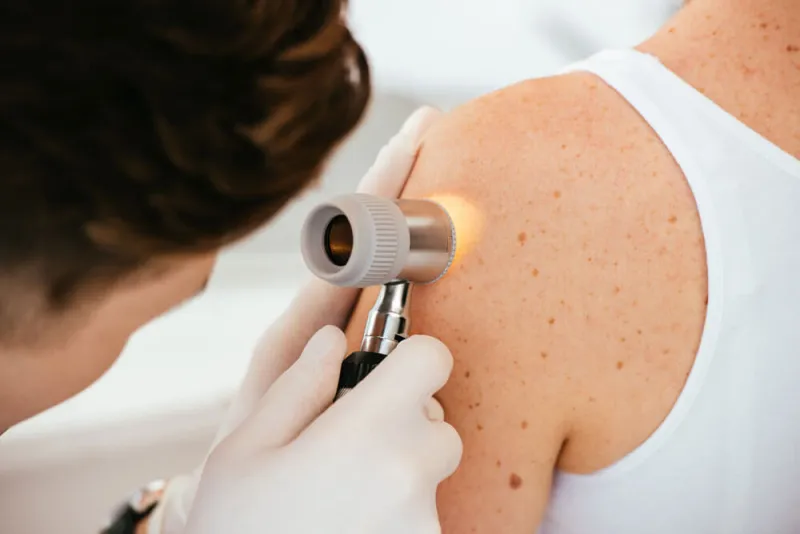
Photo: dermatologist examining scalp close up with dermatoscope clinical skin, via hudsondermatology.com
If there's one thing dermatologists hear constantly, it's some version of “I've had flakes for years, I just use a stronger shampoo.” That sentence is doing a lot of work: it's a diagnosis, a treatment plan, and a coping mechanism all at once. And it's often wrong.
Your Scalp Is Skin With Hair Growing Out of It
Start there, because most scalp advice doesn't. Your scalp has the same barrier function, the same oil glands, the same immune cells, and the same resident microbe population as the skin on your face. It also has a dense forest of follicles, which changes the physics: sebum, dead cells, sweat, and product don't shed off easily. They sit.
So when something goes wrong up there, the question isn't “what shampoo fixes this” — it's “which of several very different things is happening, and does the treatment match?”
Four Things We All Call Dry Scalp
Plain dryness (xerosis) is the least common of the four, and it usually shows up as fine, white, powdery flakes with tightness and itch but no redness. It loves winter, hot showers, and over-cleansing.
Product buildup looks like flakes but isn't. It's residue — from oils, butters, dry shampoo, styling creams, and hard water minerals — sitting on the scalp and sloughing off in clumps. It tends to correlate with your routine, not the season.
Seborrheic dermatitis is a different animal. It shows up as greasy, yellowish flakes, sometimes with redness, often along the hairline, behind the ears, in the eyebrows, or at the part. It itches more after you sweat. It's driven by an overgrowth reaction to Malassezia, a yeast that lives on everybody's scalp, and it's chronic — meaning it's managed, not cured.
Contact irritation and folliculitis round out the list: itching or bumps from a fragrance, a preservative, a henna, a new edge control, or from shaving and waxing. These often start when a product starts, which is a useful clue.
Same symptom, four different problems, four different answers. Treating seborrheic dermatitis with a moisturizing co-wash is like treating a stain with lotion.
How Anti-Dandruff Actives Actually Work
US drugstore shelves are full of actives, and they don't do the same job.
- Zinc pyrithione is antifungal and antibacterial. Mild, well tolerated, good for maintenance.
- Piroctone olamine does similar work with a gentler profile; common in European formulas and increasingly available here.
- Selenium sulfide slows cell turnover and targets the yeast. Effective, can be drying, and can shift light or color-treated hair if left on too long.
- Ketoconazole 1% is the strongest antifungal available in the US without a prescription, and it has the most evidence behind it for seborrheic dermatitis.
- Salicylic acid is a descaler, not an antifungal. It lifts flakes so other ingredients can reach skin. Great in a rotation, weak as a solo act.
- Coal tar slows turnover and reduces itch; it works, it smells like a road, and many people can't stick with it.
Rotation Beats Brute Force
Here's the part that surprises people: using the same antifungal shampoo forever is how you get diminishing returns. Malassezia doesn't need to evolve resistance the way bacteria do — but your scalp barrier does get irritated by repeated harsh treatment, and irritation looks a lot like the thing you're treating.
A practical pattern many dermatologists suggest looks like this: an antifungal (ketoconazole or zinc pyrithione) two to three times a week during a flare, left on for three to five minutes before rinsing, alternating with a gentle non-medicated cleanser. Once things calm down, drop to once a week for maintenance and keep the rest of your washes boring.
Three to five minutes. That's the instruction everyone ignores. A medicated shampoo that's on your head for forty seconds is expensive conditioner.
Gentler Cleansing Isn't a Cop-Out
You don't have to choose between treating your scalp and being kind to your hair. But you do have to stop treating your scalp like it's disposable.
Wash with lukewarm water. Use fingertips, not nails. Don't layer five products onto a flaring scalp — the fewer ingredients sitting on irritated skin, the easier it is to identify what's helping and what's hurting. If you have textured hair and wash infrequently, talk through the frequency question honestly instead of assuming a medicated shampoo can't fit; it can, with the right conditioner and technique.
The Microbiome Conversation, Minus the Marketing
Yes, the scalp has a microbiome. Yes, Malassezia is part of it. No, a $68 serum with “microbiome-balancing” on the label is not the same thing as treating a diagnosed condition. The research is genuinely interesting and still early. What we know for sure is that reducing excess oil, managing inflammation, and avoiding irritants helps the ecosystem; nothing on a shelf has been shown to rebuild it from scratch.
When to Stop Guessing
Book a dermatologist if any of these apply:
- No meaningful improvement after four to six weeks of consistent, correctly used over-the-counter treatment
- Bleeding, oozing, crusting, or patches spreading beyond your hairline
- Hair loss, thinning at the part, or broken hairs alongside the flakes
- Severe itch that disrupts sleep
- Sudden onset, especially with swelling or a rash elsewhere on the body
- You're immunocompromised, pregnant, or managing another skin condition
- It's a child's scalp
In the US, that usually means a referral or a direct appointment with a dermatologist, and telehealth is a legitimate route for straightforward cases. Bring photos of the worst days, a list of every product you've used in the last three months, and how long you actually left each one on. That history is worth more than any single shampoo.
Scalp care isn't a loyalty program. It's dermatology with better packaging — and sometimes it's just dermatology.