Why Hair Density Is the Climate Variable You've Been Ignoring
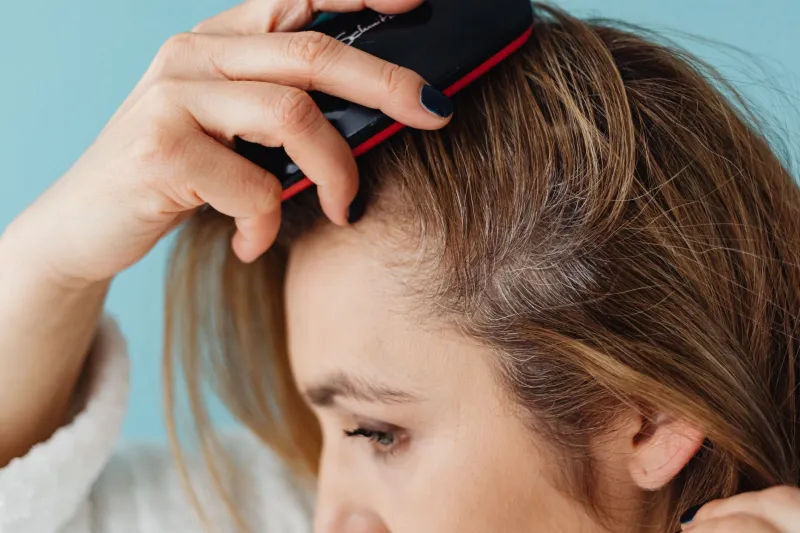
Let's get one thing out of the way: thick hair and dense hair are not the same thing. And if you've been building your whole routine around the wrong one, that explains a lot.
Most of us figure out our hair "type" from a combination of vibes, influencer content, and whatever the back of a shampoo bottle suggests. Coarse, fine, curly, straight — those are texture descriptors. But density? That's a whole separate conversation, and it's the one that actually determines how your hair behaves when the weather shifts.
So What Is Hair Density, Actually?
Hair density refers to how many individual strands are growing per square inch of your scalp. The average person has somewhere between 80,000 and 120,000 strands total, but the distribution matters more than the number. High-density hair means your strands are packed close together. Low-density hair means there's more scalp real estate between each follicle.
Here's where people get confused: you can have fine-textured hair with high density, or coarse-textured hair with low density. A person with super thin individual strands but a ton of them will actually have a fuller-looking head of hair than someone with thick individual strands spaced far apart. The texture of each strand and the number of strands are two completely different variables — and they respond to climate conditions in completely different ways.
When you're standing in Houston in August or walking through a Chicago wind tunnel in February, it's your density that's doing the heavy lifting in terms of how your hair holds up — not just your curl pattern or strand thickness.
Why Climate Hits Different Based on Density
Humidity is the big one everyone talks about. But the reason humidity affects some people's hair dramatically and barely touches others isn't just about texture — it's about how much surface area your hair collectively has exposed to the air at any given time.
High-density hair creates a kind of natural insulation. The strands are close enough together that moisture from humid air has a harder time penetrating the inner layers of your style. The outer layer might frizz or swell a little, but the overall structure holds. This is why some people with lots of fine strands report that their hair actually looks better in humid climates — there's enough density to maintain body without going flat, and the moisture in the air adds softness.
Low-density hair, on the other hand, is more exposed. Each strand has more room to interact with the surrounding air, which means humid conditions can make low-density hair feel weighed down and limp almost immediately. There's less collective structure to resist the moisture absorption, so the hair just... surrenders to the climate.
Dry climates flip the script. In places like Phoenix or Denver, low-density hair can actually thrive — the lack of ambient moisture means strands stay light and don't clump or lose definition. High-density hair in dry climates, though? That's where you start to see static, breakage, and that straw-like feeling that no amount of conditioner seems to fix for more than a day.
The Seasonal Shift Nobody Warns You About
Here's something that doesn't get nearly enough attention: your hair density is not fixed. It fluctuates throughout the year, and if you're in a part of the US that experiences real seasonal swings — the Midwest, the Northeast, really anywhere that isn't coastal California — you've probably noticed your hair acting completely different in January versus July.
Shedding cycles play a huge role. Most people experience increased shedding in the fall, which is a normal biological process. By winter, you may have noticeably less density than you did in summer. Then regrowth kicks in during spring, and by mid-summer you're back to your peak. This means the humidity-fighting strategy that worked for you in August might actually be overkill by October, and the lightweight products you relied on in winter might not be doing enough come June.
Hormonal shifts, nutritional changes, and even stress can accelerate or slow this cycle. The point isn't to panic — it's to stop assuming your hair has one fixed identity that should respond the same way to the same products all year round.
How to Actually Figure Out Your Density
Forget the Instagram tests where you hold up a strand to the light. That tells you about thickness, not density. To get a rough read on your actual density, look at your scalp when your hair is dry and unstyled. Part it in a few places. If you can see a significant amount of scalp without really trying, you're likely on the lower end of the density spectrum. If you have to really work to see your scalp through your hair, you're probably in the medium-to-high range.
Another approach: take a section of dry hair and gather it into a ponytail. If the circumference is less than about two inches, you're working with lower density. Two to three inches puts you in the medium range. Above three inches and you're in high-density territory.
This isn't a perfect science, but it gives you a working baseline — which is more than most product labels are going to give you.
Matching Your Products to Your Density and Climate
Once you know where you land, the product logic starts to make a lot more sense.
Low density in humid climates: Your enemy is weight. Avoid heavy creams, oils, and butters as your primary stylers — they'll flatten what little volume you have and make your hair look stringy as soon as the air gets thick. Look for lightweight mousses, volumizing sprays, or water-based serums that provide hold without coating the strand. Humidity-resistant formulas are worth the investment here.
Low density in dry climates: You actually have some flexibility. Lightweight oils and leave-ins can add the moisture your strands are craving without the collapse risk you'd face in a humid environment. Focus on sealing in hydration before the dry air strips it out.
High density in humid climates: Your hair can handle richer products, and it may actually need them. Heavier creams help keep your strands collectively weighted and defined, reducing the surface frizz that comes from outer layers reacting to moisture. Anti-humidity sealants applied on top of your styler can add an extra layer of protection.
High density in dry climates: This is where you really need to prioritize moisture retention. Deep conditioning treatments aren't optional — they're infrastructure. Look for products with humectants like glycerin or aloe, but check where they land in the formula. In very dry climates, pure humectants without a sealing agent can actually pull moisture out of your strands and into the dry air, making things worse.
Your Hair Doesn't Need to Be Fixed — It Needs to Be Understood
The beauty industry has a habit of selling us solutions to problems we've been mislabeled with. If you've been chasing the wrong variable — fighting your "thick" hair when the real issue is density, or blaming humidity when the real problem is a product mismatch — it's not because you failed at hair care. It's because nobody handed you the right map.
Density is that map. It's not glamorous, it doesn't trend on TikTok, and it doesn't have a cute acronym. But it's one of the most practical things you can understand about your own hair — and once you do, a lot of the frustrating randomness starts to make sense.
Your crown deserves better than guesswork. Start with the right data.